Showing posts with label The Power of super 8 film. Show all posts

Monday, July 16, 2012

5 Cool Things You Can (and Should!) Do with Your Home Movies!


Tech Talk: 5 NEW Cool Things You can (and should!) Do with your Home Movies!

We already share pictures with friends over the internet and upload instantly from our electronic devices. Why not do the same with your home movies?

The ability to bring cinema into the home for personal story telling changed us as a culture and continues to impact us today. These aren’t just “some old home movies” to watch on an old projector at Thanksgiving! They are the stories of our lives that can provide insight, enjoyment and humor to our families all year long. Technology has given us the ability to share our legacy in a way never before possible. Here are some ideas to get you started:

1) Upload your home movies to cloud via YouTube or Vimeo: Since being found in 2005, YouTube is the world’s most popular online video community, allowing millions of people to discover, watch and share originally created videos, and bring personal stories out of the living room and onto the worldwide web. It is free and easy to set up a YouTube or Vimeo site dedicated to your home movies. It is a simple as signing up with your email address, and start uploading! You will get a dedicated web page (i.e.: www.youtube.com/VigeantHomeMovies) that you can cut and paste virtually anywhere. Home movie clips can be set as private or public, with password protection if you only want certain family members to have access to them. If you are looking to share publicly, you can “tag” names, places, dates and events in the clip. These key words will come up in the Google search. Bonus! When a video clip lives on “the cloud,” it makes a great back up of your home movie files in case of a catastrophe. Floods, Fires, Hard Drive crashes; you name it, it has happened! By storing your files on the World Wide Web in the cloud they are protected even if a disaster occurs.

2) Burn Them to Disc- Blu-Ray with WiFi:
Since 2008, the cost of Blu-ray players has come down significantly, even for a very high quality player. The manufactures have added new features that make the players more universal. A new Sony BDP-S390, (is around $100) plays: BD-R (Recordable Blu-Ray) in perfect FULL HD 1080p at amazing quality, regular DVD, and has Wi-Fi capabilities with applications such as NetFlix, YouTube, Pandora and more built directly into the player! (This is another great way to watch that YouTube channel you just created on your television instead of the computer! J) Many of the newer players also have a USB 2.0 universal flash drive component, allowing you to play virtually any media such as music, photos and films, through your Blu-Ray player. If you are thinking about putting your home movies on Blu-Ray to share with the family, a new Blu-Ray player is essential to making these components run smoothly.

3) G-connect- Wireless storage for your iPad: It may not be feasible to carry your new Blu-Ray player around wherever you go, but if you have an iPad, you already know that the portability of this device is one of its greatest assets. In order to play your home movies on an iPad, they have to be recorded in an Apple TV (.m4v) file format. You then have to upload the file to your computer from your hard drive, connect the iPad, and down load the file. But at-last! G-Technology has just come out with a portable, wireless storage device for your iPad or iPhone. It is designed for “on-the-go” access to your content, by streaming it directly into your iPad using WiFi, without ever downloading the files to your computer or the iPad itself. Upload your home movies to the G-connect device (instead of a hard drive) and you are ready to go. Very cool! You will knock the socks off grandma with this one!
http://www.g-technology.com/products/g-connect.cfm


4) Edit: Imagine yourself as head of your own studio, editing your home movies to tell a specific story. Just like in the studios, the editor has the power to bring a story together in a creative and emotional way. With all the tools readily available on your home computer, it is easy to repurpose your original films into edited story telling.

A Story….Last Christmas one of my family members made me a 5 minute montage of all the family Christmas, starting with my grandparents in the 1950’s through my own adulthood. Edited to ‘Have Yourself A Merry Little Christmas,’ I saw 3 generations- my grandparents, my parents, and myself as children opening our gifts and playing with our new toys on Christmas morning. It was so fun to see how the traditions of our family Christmas have stayed true through so many years.

Today all Mac computers come with a program called iMovie, which allows you to cut clips and put your films to music. PC’s also typically come with some type of editing software such as Windows Movie Maker. For the more ambitious or experienced editor, you can purchase an editing software program such as Adobe Premier (PC editing) or Final Cut Pro X (Mac editing.) These have many more options for creating special effects that punch up your editing.

Creating your own short story or music video can be amazingly fun, easy, and a great way to re-purpose original content into funny, serious, or loving stories to share with your family.  Gift it to family members for birthdays or holidays. On a more serious note, edited clips of an individual could also been used devotedly to portray ones life and help families heal through hard times when a loved one passes. A montage clip of the person’s life can play at a wake or funeral, giving friends and family comfort through the moving images and happy times of a person’s life.

5) Funding: Technology has given us the ability to share our legacy in a way never before possible, and there couldn’t be a more exciting time. Many families are overwhelmed by the expense of treating their home movies like the studios would, even though in their hearts, they know that is what they would like to do. There are now several options to get funding for your home movie transfer!

Crowd Funding: There are now several websites where you create a fundraising campaign, called crowdfunding,’ to raise money for personal projects. Someone in your family may want to propose that everyone in the family makes a donation, which could be used to digitize everyone’s material, and then everyone in the family could get the entire library on a hard drive and edit their own story. Project goals might include organizing the entire library on a hard drive, iPad, Blu-Ray or uploaded to the cloud. Some examples of Crowd Funding platforms include Kickstarter.com, GoFundMe.com, IndieGoGo.com, ChipIn.com

Stock Footage: Could your family home movies be worth money? You bet they can! A single clip of 8mm film sold on Getty Images for over $5,000! How is that possible you may ask? Filmmakers are often looking for authentic 8mm clips that capture specific events, people, time periods and so much more so that they don’t have to go to the added expense of re-creating them. These clips are called Stock Footage, and are made available to the public by posting short clips onto the web. When transferred professionally, there is greater likelihood that your clips could be purchased and downloaded to be re-purposed in documentaries, films, television shows, and more.   As long as the films are your original material, your home movies could be the most valuable asset in your attic! Stock Footage platforms include GettyImages.com, Pond5.com, istockphoto.com and many more!

Thanks for reading 5 NEW Cool Things you can (and should!) do with your Home Movies!! As you may have figured out, this is just a short list among hundreds of applications for watching, editing, playing and funding your home movie project. So what are you waiting for!

Have a home movie idea you would like to share? Post it here or email us at info@pro8mm.com to share your idea in our next newsletter!


© Pro8mm 2012. www.pro8mm.com

Friday, October 28, 2011

The Master vs. The Playout: Archiving and Playing your Film the RIGHT Way

While digital has presented itself as great way to watch and edit film, it has also caused lots of confusion for home movie archiving. Having worked on thousands of home movie archiving projects over the past 3 years in high definition, the colorists at Pro8mm have had a few solid revelations about this process.

One revelation is that there has not been a solid solution to the quest to find one universal digital HD format that works well for both playing movies and for archiving them. Unfortunately, what is good for archiving is not the best format for easy playback. This means that in order to have the best access to your home movies you need to see it as two formats: one for preserving your movies and one for watching them. For name sake lets call one the “The Master” and the other the “The Playout.”

Rhonda with home movies on her iPad
A master digital file is going to be the best in terms of future protection of your images because a true master is going to provide you with data in the highest quality you might require and give you the flexibility of creating different playout versions.  The best digital master must serve your needs today, tomorrow and even to generate playouts for past systems. By having a master, you will always have a way of creating the highest quality playout file to a format that is most convenient for that times. For example, today it is ‘cool’ to watch your movies on your iPad or stream them to something like Facebook, but it was not that long ago we were using DVD’s and not that long before that we had VHS. Playouts will continue to change, but the great evolution towards HD mastering has stabilized. Hard drives may get faster and cheaper, but the fundamentals of HD are now securely planted.

The master is great as a film preservation medium but having the capacity to use it as a good playout is often very frustrating.  Many things must be in sync, coded correctly and you have to have the capacity to play large file types to use a master as a playout.  Computer files can be easily be down converted to what you need for a specific playout application.  This can be done while scanning or after you do some editing to the mater files. The cost to create these specific playouts is small. So the best system is to have both a master and playout files for the various ways you want to watch your films. At Pro8mm, we can create a specific playout file for DVD viewing, Blu-Ray, your iPad or even a format to stream your home movies on YouTube or Facebook.  These Playout files are specifically formatted for these devices so that you can have correct playback speed and framing for a playout that is different from the master.

SD Masters & Playouts
For almost 20 years we used Digi Beta Tape as the masters format for storing home movies. Over the past 3 years we have experienced the evolution to HD mastering and have seen first hand the great improvement HD mastering offers for Home Movie Archiving.

There are three areas of tremendous improvement with an HD File master over Digital Beta.

1) You no longer need Ghost Frames: Whenever you create SD video from film, you have to have 30 frames per second. This is how video works and there is no changing it in a Standard Definition NTSC system. If you shot film at 18 or 24fps, you needed to create the additional frames to make a 30 frames system work.  These extra created frames where often referred to a ghost frames because the where created out of two frames of the original film. In SD, they were rarely noticed because of the low resolution of the system.  The only time you could see these frames is if you played back the video frame by frame. You would then see these added frames that often blurred part of the images in the frame. However in high definition, because of the increased resolution the ghost frames are noticeable and can be seen when you playback the video. These extra frames did nothing but take up space, create unwanted artifacts, and reduce the quality of your master.   But they where needed to make the system work.  Today, with HD scanning we can store the images frame-by-frame in the digital mastering. We no longer need these extra ghost frames to make the system work. 
2) You now have more digital to define your film: The second  improvement of HD digital mastering is having more digits to describe your frames. Typically in HD we use a 1920 X1080 standard 16x9 Mastering format. In SD,  NTSC we used (640 X 480). With HD, there is 4 times more digital to describe the detail in every frame of film from SD.  This gives you the opportunity to store more color space and finer details about every frame. A lot of detail and color can fit in 4x more space.

Lacie Rugged Hard Drive

3) The Hard Drive: The last improvement is the storage of your images. The hard drive provides you with unprecedented access at very little cost. There is no longer a need to have those very expensive tape decks to maintain masters. With SD you needed multiple tape decks because different kinds of digit was put on different kinds of tape. If you wanted to have your data in both Digital Beta NTSC and for Europe Digital Beta Pal you would need two $40,000.00 tape machines to have access to your masters. Today with hard drives,  you can store both files on a single drive. Oh and by the way, you no longer need to have two masters because you can create both a Pal and NTSC payout from a single HD Master.   Second, you can compress the data, copy the data and manipulate the data with a simple consumer computer and the right software.  You can make 2 copies of the master for preservation, you can compress some files for theI internet to stream on Youtube, and you can make the grandparents a DVD.  You now have access to all your materials, both master and playout without the cost of expensive, multiple format tape decks. Hard drives will keep getting faster and cheaper, so you can migrate your data to what ever new system of storage presents itself.

To learn more about home movie preservation and digital asset management, we are hosting a free live event and teleseminar the second week of November called “Don’t Delete My Memories: The Home Movie Conundrum Made Simple.” Learn best practices for preserving and protecting your home movie digitally and understand the ways of using your home movie archive in modern applications. We will also be announce some amazing holiday promotions just for home movie preservation. Learn how to create great holiday gifts and memorable holiday events with your home movie archive.

Click here to Register for the LIVE event in Burbank, CA - Tuesday, November 8 from 7pm - 9pm

Click here to Register for the VIRTUAL event - Wednesday, November 9 from 4:30pm to 5:30pm pacific


Thursday, July 21, 2011

Shooting National Brands with Super 8 Teleseminar

Today more than ever big national brands are forced to recreate their image and reconnect with their customers in more intimate, engaging and organic ways. Modern society tends to be very isolated and spread out as the internet makes it easy to connect facelessness through sites like Facebook and apps like Twitter.

Many companies are now focusing on personal story telling to re-focus on individual contributors as opposed to corporate culture. What better way to do this than with Super 8 film? 

On Wednesday, August 3rd, 2011 at 4:30pm pacifiwhole foodsc, Phil Vigeant, super 8 expert and author, along with special guest, Laura Merians, who tells personal stories about Whole Foods products through Super 8 film, will be taking an in-depth look at Shooting National Brands with Super 8.
Laura and Phil will be talking about how and why some very hip campaigns for companies such as Roxy, Billabong, Whole Foods, Swiffer, Ford Automobiles and hundreds of other national brands for food, beverage, clothing, sports teams, fast food resturants and more use Super 8 in their campaigns.

 laura meriansLaura Merians is a cinematographer and director based in Los Angeles and New York City. She started her career in lighting after receiving a degree in Philosophy from UC Berkeley. Laura has worked on projects for Discovery, MTV, VH1, Fox and Sony well as shooting music videos and short films. Her work has been featured in American Cinematographer, Studio Monthly Magazine, Videography Magazine and Digital Cinematography.  She recently finished shooting and directing a series of shorts for Whole foods on urban farming called GROW and a new series for the Style Network titled Tia and Tamera; she used Super 8 on both projects.

Register Now for this FREE teleseminar! Wednesday, August 3, 2011 4:30pm to 5:30pm pacific (7:30pm to 8:30pm eastern)

Click Here to Register! 

Friday, June 10, 2011

Super 8 Filmmaking is Alive, Well and Remains a Hot Production Medium at the One-Stop Burbank Shop - Pro8mmSuper 8 Filmmaking is Alive, Well and Remains a Hot Production Medium at the One-Stop Burbank Shop - Pro8mm


The release of the J.J. Abrams film Super 8 is bringing renewed attention to the popular film format which millions of families captured their home movies on during the 60’s, 70’s and 80’s. The format gave a vehicle for today’s most beloved filmmakers to experiment with a home movie camera that proved to be the gateway to some of the most prolific careers in filmmaking.  Directors such as Steven Spielberg, George Lucas, Oliver Stone, Sam Rami, Tim Burton, Francis Ford Coppola, and Ron Howard, among many others, have all launched careers that have roots in Super 8 film.   As kids, they picked up the family Super 8 camera and saw it as much more than a tool to make home movies.  They used Super 8 as a production tool to experiment with a craft. This is the theme that runs through J.J. Abrams film Super 8 -  a group of kids who were making a real independent movie for a film festival with a Super 8 camera. 


While the general belief is that the Super 8 format died an honorable death with the advent of consumer and prosumer video, Hollywood insiders and savvy independent filmmakers know that the power of super 8 film is alive and well in Burbank, CA!

The company Pro8mm (formerly called Super8 Sound) has been working on over 1,000 professional projects every year since the mid 1980’s. Pro8mm hit its heyday in the 1990’s, working on every episode of VH-1 Behind The Music, Where Are They Now, and numerous MTV shows and specials.  This love of super 8 continues, with recent music videos shot on Super 8 film for such artists as Katy Perry, Beyonce, Christina Aguilera, Harper Simon, McFly, and  John Mellencamp. Commercials for consumer products such as Whole Foods, Ford cars and trucks, Swiffer, Home Depot, Billabong and Roxy, as well as inserts in TV shows such as American Idol, 48 Hours, The Grammy’s, and My Name Is Earl have all embraced the Super 8 format.  Additionally, 35mm theatrical releases such as Super 8, 8mm, My Sister’s Keeper, and Factory Girl have incorporated Super 8 inserts to create the sense of flashback scenes and vintage moments throughout their feature films.  This list is just the tip of the iceberg for professional applications that the Super 8 format has worked particularly well for.

Additionally, Pro8mm specializes in the HD archival transfers of homes movies and historical films for use in museums, documentaries or the personal archives of the worlds most famous faces. Pro8mm’s projects include the Hewlett-Packard Family and The Estee Lauder Family, The Richard Nixon Library, and tour footage from The Eagles “Hell Freezes Over” tour. Pro8mm has also transferred the first films of many famous directors and cinematographers.

Pro8mm focuses on a hybrid of products and services that make it possible for filmmakers to do professional production work with the Super 8 format. Pro8mm turns its work around very quickly, even the same day if needed.  All services are on-site, including a retail store for purchasing or renting cameras and film, the processing lab, camera technicians, and the scanners, which digitize the film in 1080 high definition to a hard drive for ease of editing.

Pro8mm rebuilds classic Super 8 cameras with modifications that a modern filmmaker would want, such as 16:9 aspect ratios and sync sound. Pro8mm also reformats over 20 different Super 8 film stocks, cutting down Kodak and Fuji 35mm film. This gives cost effective access to the same film stocks being used to make Hollywood blockbusters. Recently, Pro8mm invested over one million dollars in a Millennium II, 4K scanner, with daVinci 2K color correction, custom modified for Super 8, regular 8 and Max 8 formats.  This is the same type of scanner you would see at a high-end 35mm post-production facility.

Over the past two years, Pro8mm has made a monumental commitment to educating the next generation about the benefits of shooting on Super 8 film.   In 2010, Phil Vigeant, President of Pro8mm, wrote a book titled, “The Power of Super 8 Film – Insider Secrets Every Filmmaker Should Know.”  The book focuses on why the pros use it, love it and keep it a secret. Phil gives his expertise on the format and explains why he invented products that change the way filmmakers and the entertainment industry use Super 8 film.  Additionally, Pro8mm has launched a series of free teleseminars that focus of Super 8 applications and technical information about the process. Pro8mm has expanded their educational products by offering free hands-on film workshops at schools, major industry events and even private workshops at their shop. Pro8mm also hosts their own 2 day Super 8 training workshop, where Phil Vigeant gives in-depth technical sessions on Super 8 filmmaking, and guest speakers talk about and show samples shot on Super 8 film of the many applications of Super 8 such as weddings, commercials and music videos.


COMPANY HISTORY:
Founded in 1971 in Cambridge, Massachusetts, the company, which was originally called Super8 Sound ™, pioneered the belief that the Super 8mm film format had tremendous potential as a production medium.  History Of Super 8 Sound . A small group of inventors and entrepreneurs designed a line of specialty sync-sound full coat (audio tape that has sprocket holes) and cassette recorders, editing benches and crystal sync modifications to Super 8 Cameras and other production accessories. The idea was that you could replicate 35mm filmmaking using Super 8 equipment. This indeed made the Super 8mm film format and Super8 Sound ™ an integral part of hundreds of university film programs worldwide. Film programs could teach in double system filmmaking on cost efficient super 8. It became widely used by individuals with a desire to make independent films. 

In 1982, Super8 Sound employee and staff accountant Philip Vigeant had the opportunity to buy the company. In the years that followed, Vigeant bought out other small companies in the Boston area including a film lab and a camera repair shop adding their services to Super8 Sound™.

A film chain telecine which transferred film to videotape was also added that year with the firm belief that the future of small format film laid in the ability to integrate it into the video arena. An in-house publication called The Independent Producer was launched which focused on the success of the independent film scene, focusing on people who were shooting on super 8. The magazine highlighted the stories of individuals making low-budget super 8 music videos and film for video distribution.

In 1987 Super8 Sound expanded the business by opening a second office in Hollywood, California. This expansion was driven by the amount of clients the company had on the west coast who were involved in producing MTV style music videos for their bands.

In 1989, another expansion was implemented to a larger Burbank location, adding a technical camera repair room, on-site processing lab, and film to videotape transfer services. Now a complete turnkey, one-stop shop, the company redirected it’s focus to meet the demands of there growing list of studio and industry mainstream clients. The Boston office was eventually closed in 1995. The Rank Cintel telecine suites with daVinci color correction were added, permanently eliminating film chain consumer quality transfers.

 One of the biggest innovations for the company came in 1993 with the development of a line of Pro8mm negative film. Prior to this, only reversal super 8 film stocks were available from major film manufactures such as Fuji and Kodak. The idea was that a line of professional film stocks in the familiar easy to use 50-foot preloaded cartridges would offer a palette to filmmakers allowing for greater creative options for the cost efficient, highly portable super 8 format.

The company developed a manufacturing operation on-site to cut and reformat professional 35mm film stocks, loading it into super8 cartridges. All-inclusive packages were offered so that film, processing, and telecine could be prepaid, allowing for better targeting of the production budget. The industry, students, and independents embraced this concept with huge enthusiasm. Today Pro8mm has an expansive line of over 20 reformatted film stocks that range from 50-500 ASA and 3 different scanning systems, including high definition. In addition, they repackage Kodak Super 8 film stocks to include their award winning processing and HD scanning services.

Over the next 10 years thousands of projects were shot on Pro8mm film including dozens of episodes of VH-1 Behind the Music, hundreds of commercials, segways for prime time television shows, and scenes in theatrical releases.

The name of the company was changed to Pro8mm in 1998, which was more in line with the company’s mission statement and goals. Professional Super 8 and
Pro (in favor of) 8mm. The days of sound on film and mag full coat recorders were gone and the new direction of the company would be to integrate the small format film into the digital world. Profound changes were to follow to bring Super 8 into the HD world.

In 2003 Pro8mm expanded the small format product line to include Pro16mm, loading 16mm film onto 100’ daylight spools, rebuilding classic 16mm cameras and expanding our processing and telecine services.

Aligning with prosumer and industry trends, 2005 brought Pro8mm into the widescreen era with the introduction of  Max 8, a 16 X 9 widescreen super 8 camera and scanning system. Pro8mm began building classic cameras with a new expanded gate, allowing for 20% more image to be captured where the old sound stripe used to be on the film. The development of modern aspect ratio products and scanning committed Pro8mm to be on board for the world of high definition and the future.

In late 2007, Pro8mm began purchasing HD Scanning Equipment and set up an HD Scanning Suite. Their Millennium II HD Scanner and 2K daVinci Color corrector gave Pro8mm the capability to move forward by both preserving archival material in HD or by directing scanning in native 1080 off the frame, and accommodating our production clients as all broadcast moves to digital.

As a generation of filmmakers began to finish film school without ever shooting a frame of real film, 2010 brought the company to the realization that they needed to make a hefty commitment to educate people on how to shoot on Super 8 film. Company president Phil Vigeant wrote a book called  “The Power of Super 8 Film – Insider Secrets Every Filmmaker Should Know and the company began running free shooting events, teleseminars, workshops, and two day Boot Camps for a nominal fee. 

Pro8mm is applauded for being a one-stop shop where Super 8 cameras, film, processing, digital mastering, hands on training and treasured family archival home movies can all be handled by a dedicated staff with decades of experience. The company has enjoyed continuous growth for over 40 years in a niche market that in our opinion continues to thrive because of the dedicated hard work and entrepreneurial spirit to continuously move forward in alignment with the media industry.

Check out Pro8mm at www.pro8mm.com or call 818-848-5522

By Rhonda Vigeant, Director of Marketing  Rhonda@pro8mm.com

Wednesday, March 24, 2010

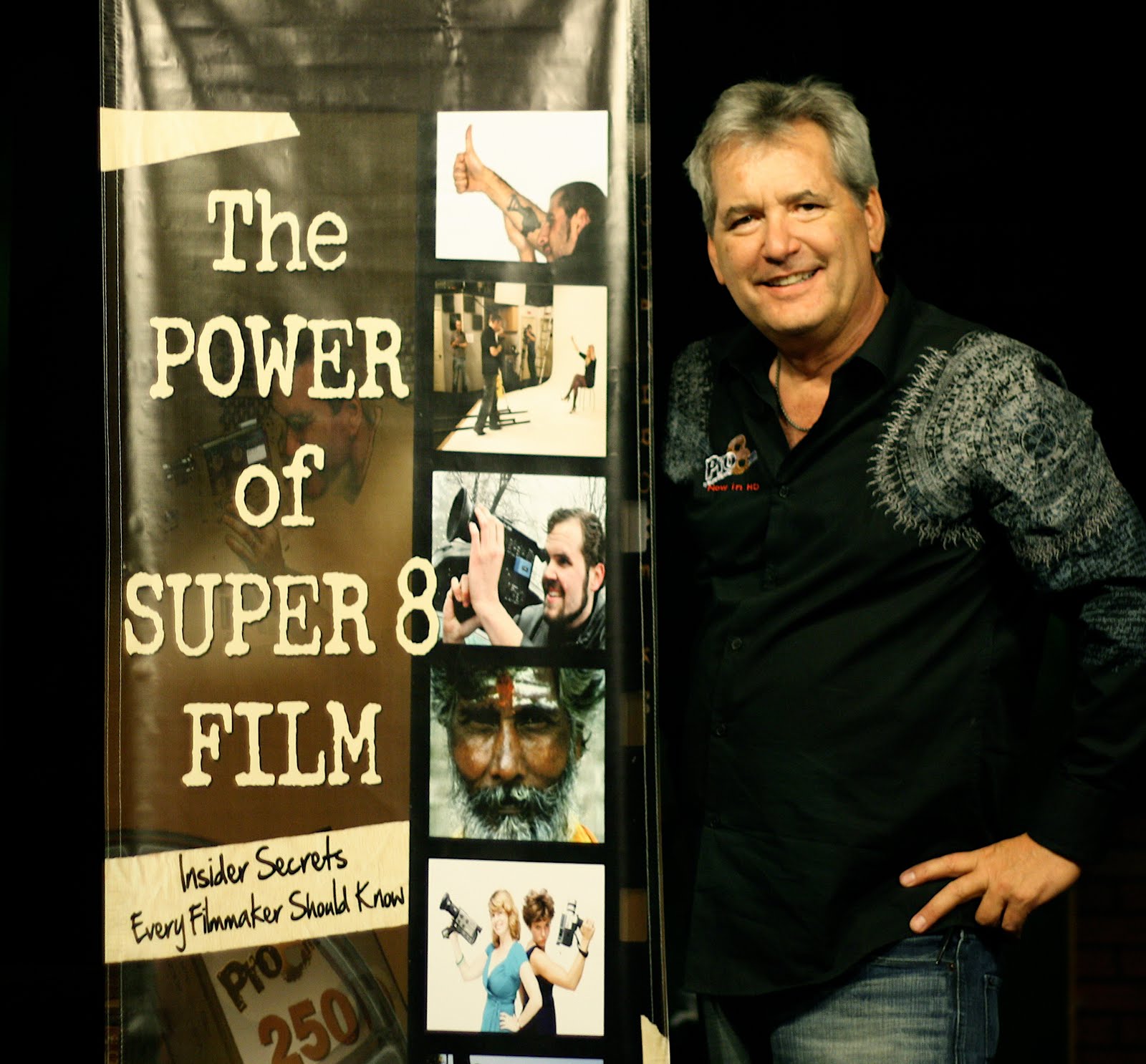
The Power of Super 8 Film - A New Book by Phil Vigeant

Super 8 Film Book

The Power Of Super 8 Film
-Insider Secrets Every Filmmaker Should Know
by Phil Vigeant, President, Pro8mm, Burbank, CA


Many emerging filmmakers spend a fortune on equipment, expensive university film programs, private filmmaking boot camps, or over priced post-production, that often renders mediocre quality, and they still feel as if something is missing. They look at their progress as marginal compared to their financial investment, time commitment and ability to work the craft. That is the purpose of this book. Filmmakers will get the expertise I can offer from running my company, Pro8mm that has worked with industry insiders who have shot Super 8mm film for over 30 years. The Power of Super 8 Film illustrates why I invented products that changed the way filmmakers and the entertainment industry have used Super 8 film, emerging from a format used to shoot home movies in the 1950's-1970's to a professional production medium. Pro8mm workflows have been used in hundreds of commercials for national brands, dozens of 35mm theatrical releases, and award winning music videos and television shows. The Power of Super 8 Film will guide filmmakers through the steps they should take to immediately get the experience of shooting film on film, the way all the greats did.

The book is written in a non-technical style that will be easy for any newcomer to film to understand, while providing fantastic tips for filmmakers at any level on finding cameras, shooting different film stocks, choices in processing techniques and integrating Super 8 film into digital workflows and new media applications. I explain how to get a huge bang for your filmmaking buck by using an inexpensive Super 8 camera, a 50 foot cartridge of film, chemistry and the very best in digital scanning.

This book fills a much needed void among other books written on cinematography as it encapsulates the use of Super 8 film as a professional production medium giving real examples of work done in the format. It is not a technical manual on focus, lighting or other technical nuances of the craft, (of which there are plenty of existing references) but rather a guerilla guide that gets down to the nuts and bolts of Super 8 today. Nothing else like this currently exists.

The book is 104 pages, paperback and is available for $14.95 at www.pro8mm.com